





















A RELATIONAL PERSPECTIVE ON CONSCIOUSNESS, INFORMATION AND WELL-BEING
Guest Contribution by Carlos Pinto
INTRODUCTION
Modern science and everyday thinking rely on clear distinctions. We separate matter from energy, mind from body, organism from environment. These distinctions are useful and often necessary. They allow us to build models, generate predictions, and navigate complex systems.
Yet this way of structuring reality has limits. By focusing on parts, we may overlook relational patterns that extend across boundaries. The present reflection starts from a simple idea: reality may be better understood as a coherent structure of relationships, in which energy, information, and interaction are inseparably linked. From this perspective, boundaries function as practical tools rather than fundamental divisions.
EXISTENCE AS A CONTINUOUS CONDITION
In mathematics, concepts such as infinity or cardinality provide precise and powerful abstractions. They are indispensable within formal systems, yet far removed from direct experience. As a result, aspects of reality that resist measurement or formalization often remain conceptually marginal.
Here, the notion of existence is introduced as a complementary concept. Not as a replacement for mathematical infinity, but as a way of pointing to the continuous condition that allows anything to appear at all. Existence, in this sense, is not a quantity or a number. It refers to the ongoing background within which experiences, events, and distinctions arise and dissolve.
Seen this way, familiar separations between past and future, organism and environment, or matter and energy remain meaningful, but no longer absolute. They emerge contextually within a larger, continuous whole.
INFORMATION, INTERACTION, AND RESONANCE
Within a connected structure, nothing exists in isolation. Every system interacts with its surroundings by receiving input, processing it according to its internal organization, and producing output. Described neutrally, this is information exchange.
Each structure responds in ways shaped by its constraints and capacities. This can be understood as a signature that governs interaction, without implying consciousness or intention. The same principle applies across scales, from molecules to organisms, ecosystems, and planetary systems. Observed behavior arises from relationships and feedback rather than from isolated components.
From this perspective, consciousness does not need to be treated as something that suddenly appears at a specific point. It can be understood as a spectrum of information integration that becomes richer and more complex in certain systems. This view resonates with research in complex systems, neuroscience, ecology, and quantum information, all of which emphasize emergence and interdependence.
THINKING AS ATTUNEMENT
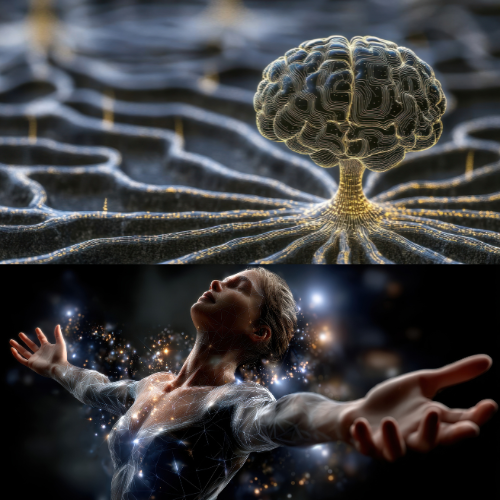
It is commonly assumed that the brain produces thoughts. An alternative interpretation is that the brain functions as a receiver and translator of information. It continuously integrates signals from the body, the environment, and internal states, rendering them accessible as thoughts, perceptions, and emotions.
In this view, insights are not created from nothing. They emerge when neural structures are well attuned to the information they process. Much like a radio does not create music but makes a signal audible, the brain may render underlying informational patterns available to conscious experience.
Reports from neuroscience and medicine, including rare cases following brain injury or neurosurgical procedures, illustrate that this perspective is at least conceptually plausible. Such cases are not presented as proof, but as boundary phenomena that invite reflection on how information, brain activity, and experience are related.
YOU MAY ALSO LIKE

INFORMATION ACROSS TIME AND SYSTEMS
Research in epigenetics has shown that environments and experiences can influence gene expression without altering DNA, and that such effects may persist across generations. Stress and trauma are well studied in this regard, but the same mechanisms raise questions about the long term impact of supportive conditions such as care, stability, and resilience.
From a relational perspective, actions are rarely isolated events. Their effects propagate through interconnected systems, not as moral judgments, but as natural consequences of participation in a shared network. Influence moves in multiple directions and across timescales.
IMPLICATIONS FOR TIME, INFLUENCE AND WELL-BEING
If interconnectedness is taken seriously, time itself may be understood less as a fixed linear sequence and more as a framework for organizing memory, expectation, and meaning. Reality unfolds continuously in the present, while past and future shape how that unfolding is experienced.
Within such a framework, well-being does not arise in isolation. It emerges from attunement, to oneself, to others, and to the systems one participates in. Influence is never one way. Attempts to shape environments, narratives, or choices inevitably generate feedback within the same relational field.
This gives a grounded meaning to ideas often described metaphorically, such as karma or resonance, not as metaphysical reward systems, but as structural consequences of continuous interaction.
CONCLUSION
This reflection does not propose alternative physics or reject empirical science. It offers a conceptual lens through which existence can be understood as a living structure of relationships and information exchange.
At the very least, this perspective suggests that experiences are not fully isolated, that actions propagate through connected systems, and that creativity and insight are more likely reflections of attunement than of chance. In this sense, well-being becomes less a personal achievement and more a shared, emergent property of how we relate, attend, and participate in the fabric of reality.

Please login to join discussion